Madeira Tax Rates
(IRS - Imposto sobre o Rendimento das Pessoas Singulares)
Madeira individual income tax rates are progressive up to 45.88%.
Taxable income (EUR) Tax Rates
Normal Deductible Amount
Up to 4,793 8,58% -
Over 4,793 until 7,250 11,08% 119.83
More than 7,250 until 17 979 22,58% 953.58
More than 17,979 up to 41,349 33,38% 2,895.31
More than 41,349 until 59,926 36,88% 4,342.52
More than 59,926 up to 64,623 39,88% 6,140.30
More than 64,623 up to 150,000 41,88% 7,432.76
More than 150,000 45,88% 13,432.76
A person is considered to be resident for taxation purposes if he is physically present within Madeira for at least 183 days during a tax year, or if an individual has his permanent residence, meaning that he is domiciled within the jurisdiction. Residents are liable to pay taxes on their worldwide income derived from employment, self-employment, commercial profits, capital gains, agricultural activities, rents, pensions and several other sources. Nonresidents are liable to pay income tax only on income derived from activities conducted in the jurisdiction and Portugal, including income from investments, pensions, employment, commercial activities, scientific artistic or technical services. After having applied various deductions, income tax is levied on a scalable basis, depending on the total income of an individual in a tax year, starting from 8.58% and up to 45.88%. The tax system for Madeira is governed from Portugal.
Madeirans are subject to a tax year equivalent to a calendar year, and with the exception of pensioners receiving only very low pension incomes and those who pay a final and accepted withholding tax, everyone else who meets the criteria of financial residency is legally obliged to submit an annual tax return, or face a penalty for late or non return.
With possible annual variations, those on only salary or pension incomes are expected to file their tax return by the middle of March, and those with other incomes have until the end of April. To do this, you go to your local Finanças and ask for the form Modelo 3. That form will act as your tax return, and will also tell you which other forms (appendices) you will need to complete, depending on the different types of income and allowances you are declaring.
Madeira Corporate Tax Rates
(IRC - Imposto sobre o Rendimento das Pessoas Colectivas)
Madeira corporate income tax rates are up to 20%.
Corporate Income Tax Rate
Taxable income up to €12,500 10%
Taxable income over €12,500 20%
Madeira Tax Benefits
International Business Centre of Madeira (IBC)
The present tax regime allows the incorporation of new entities within the legal framework of the International Business Centre of Madeira (IBC) until the end of 2013, granting significantly reduced corporate tax rates until the end of 2020 as well as no withholding taxes.
Newly established companies licensed to operate within the legal framework of the IBC of Madeira will benefit from the following reduced corporate tax rates in Maderia up to year 2020:
Years Tax Rate
From 2007 to 2009 3%
From 2010 to 2012 4%
From 2013 to 2020 5%
In the case of services activities, the reduced rates are applicable to profits derived from operations exclusively carried out with non-resident entities or with other companies operating within the ambit of the IBC of Madeira. There are no restrictions, nevertheless, on the development of business activities with Portuguese companies which will be taxed at the normal corporate tax rate in Madeira, 20% from 2008 onwards.
Production and assembling activities carried out by companies in the Industrial Free Trade Zone of Madeira, on the other hand, will benefit from the tax reductions also in operations with portuguese residents.
TAX BENEFIT REQUIREMENTS
The use of the low tax rates requires creating a certain number of jobs in relation to the taxable income / profit. To qualify for the tax reductions, companies incorporated in Madeira's IBC have to comply with one of the following pre-established requirements:
- Creation of one to five jobs in the first 6 months of operation and undertake a minimum investment of €75.000 in the acquisition of fixed assets, tangible or intangible, in the first two years of operation;
- Creation of six or more jobs in the first 6 months of operation.
On the other hand, the reduced corporate tax rates are applicable up to a ceiling placed upon the annual tax base, which varies according to the number of jobs created, as follows:
Number of Jobs Minimum Investment Ceiling
1 - 2 €75,000 €2,000,000
3 to 5 €75,000 €2,600,000
6 to 30 - €16,000,000
31 to 50 - €26,000,000
51 to 100 - €40,000,000
More than 100 - €150,000,000
It should be noted that these requirements and ceilings do not apply to the Portuguese Pure Holding companies (SGPS) licensed in the IBC of Madeira.
All joint stock companies (old corporations) licensed before 31.12.2000 are totally tax-free until the end of 2011. As of 2012 they will then be taxed at 5%. At the same time the preferential tax rate will probably depend on the number of jobs created.
madeira tax highlights
ADDITIONAL INFO ABOUT MADEIRA AND MADEIRA TAX SYSTEM
- Low tax rate (max. 5%) until 2020
- So-called old companies enjoy full tax-free status until the end of 2011 (after that 5% until 2020)
- EU turnover tax identification number
- No capital gains tax
- No property transfer tax
- No tax on capital earnings
- No withholding tax
- No gift or inheritance taxes
Madeira is an autonomous region of Portugal, which is a member state of the European Union and the OECD. Tax planners are looking to set up companies in Madeira to take advantage of low personal and corporation tax. The attractive Madeiran tax regime applies to new trading from Madeira's International Business Centre until 2020. Madeira companies also get exemption from withholding taxes on the distribution of dividends, royalties and interest payments. Particular businesses running the rule over Madeira are hedge funds and property companies. Other tax havens, like several Caribbean islands, have found that establishing tax haven status has had a knock-on effect on tourism and property investment as wealthy business people visit for meetings with tax advisors and accountants.
Entities operating within the scope of the International Business Centre of Madeira benefit from the European Union's most advantageous tax system, in terms of both direct taxation (0 to 5% rate of tax on profits) as well as indirect taxation (15% VAT, which is the European Union's lowest rate). For financial institutions approved by the Bank of Portugal and licensed to operate within the International Business Centre, higher rates of corporation tax apply.
Corporate tax exemption /reduction is applicable to all income of an industrial nature from business implemented in the Industrial Free Zone of Madeira, including income obtained in Portugal. Shareholders residing in Portugal can also enjoy the above-described tax relief.
Madeira is part of the European Monetary System (euro), a fact that provides for reduced operating costs and eliminates exchange rate risk.
Holding Companies
The SGPS is a special form of holding company. According to the EU parent-subsidiary directive, the holding company can receive dividends from other subsidiaries within the EU without any deduction of capital gains tax. The so-called old corporations with the legal form of SGPS benefit from total tax exemption up to and including 2011. Any other income of the holding company is taxed at the reduced tax rate of 22.5% instead of the Portuguese standard rate of 25%. No capital gains tax is charged for dividends paid by the Madeira SGPS.
Turnover Tax
A reduced turnover tax rate of 14% applies on Madeira, giving it one of the lowest rates in Europe. This is especially interesting for data services offered via the Internet in the form of downloads for example.
Madeira Company Types
All companies incorporated in Madeira are subject to the same company law as companies incorporated on the mainland. Here are the most common forms:
Private Limited Liability Company ("Limitada"): The Limitada has a minimum capital of € 5,000. This can be split into shares of a minimum of € 100.
Stock Corporation ("SA"): The SA is a share holding company. Its minimum capital amounts to € 50,000. Splitting shares into a minimum value of € 0.01 is permitted. Bearer shares are permitted. The minimum number of shareholders is 5.
Holding Company ("SGPS"): The holding (SGPS) can be incorporated as Limitada or SA. It only holds shares in other companies and carries out its own financial administration.
Company Form
Companies can only work within the frame of its described purpose/form. The following activity can only be carried out with a special licence: banking, health insurance, other insurance and reinsurance, asset management as well as property agency.
Madeira Free Trade Zone
The most important sources of income are tourism, wine, agriculture and fishing. In order to enlarge the economic basis, a Free Trade Zone (International Business Centre - IBC) was introduced. The special status of Madeira is accepted and sanctioned by the EU.
Madeira Customs Duties and VAT
Companies registered in the "IBC" are exempt from duties for many goods and raw materials. On incorporation, all Portuguese companies are automatically provided with a tax reference number, which is also used for value added tax purposes. The companies themselves are registered for value added tax, and when trading within the European Union can take advantage of the exemptions from value added tax on movement of goods within the European Union.
VAT on the Supply of Telecom and Digitalised Services
The advantage in supplying telecom and digitalised services from Madeira lies in the fact that Madeira has the lowest rate of VAT on the supply of such services than any other EU country.
Shipping Companies, Vessels and Yachts
Shipping companies will have full access to the reduced taxation regime of Madeira until the end of 2020. In addition, crew members aboard commercial vessels and yachts registered in MAR are not obliged to contribute to the Portuguese social security regime (provided some form of insurance is guaranteed) and are exempt from personal income tax.
Madeira Tax Year: Madeira tax year is the calendar year.
Special Advance Tax Payment (PEC): Special Advance Tax Payment (PEC) must be paid during the month of March, or in two instalments - one in March and one in October.
Stamp Duty and Capital Transfer Tax
No stamp duties are levied on the documents or transactions of companies incorporated under the MIBC Legislation.
Capital Transfer Tax applies to real estate purchases made by Free Trade Zone companies, except that the purchase of land or buildings for use as a head office is exempt. Standard rates apply: 8% for urban properties and 10% for rural ones.
Offshore Trusts
Offshore Trusts established in the International Business Centre under MIBC Legislation have Madeira-resident trustees. All income earned by a trust and all income distributed in favour of a beneficiary is free of tax in Madeira unless the source of that investment income is Portugal in which case it is taxed in the hands of the trustee.
Taxation of Foreign Employees
There is in fact no distinction between the employees of resident or non-resident operations. It is a question of individual status; residents and non-residents are treated differently of course. Most types of compensation and benefit paid to employees are taxable; there are no special privileges or exemptions for expatriate workers, except that the officers and crew of ships registered under the Madeira Shipping Registry are exempt from income and social security taxes.
Service and Financial Companies
Service and financial companies in the MIBC, including banks and insurance companies, licensed before 2001 receive tax exemption until 2011 on revenues derived from other companies within the MIBC and on revenue derived from non-residents on Portuguese territory.
In December 2002, a new regime was approved by the E.U., for companies licensed as from 1/1/2004. This new regime foresees a minimum taxation of 1% in 2003 and 2004, 2% in 2005 and 2006, and 3% in 2007 until 2011 - subject to certain limitations and conditions.
SGPS Holding Companies
The SGPS tax regime is described below:
- Dividends received relating to non-EU subsidiaries and subsidiaries domiciled in the MIBC are exempt from taxation.
- Dividends received from EU subsidiaries are treated in a similar manner to Portuguese SGPS and are entitled to a 100% tax reduction resulting in an effective rate of 0%.
- Dividends paid to Portuguese non-residents and companies domiciled on the MIBC are not subject to withholding tax.
- Capital gains relating to non-EU subsidiaries and subsidiaries domiciled in the Madeira IBC are exempt from taxation.
- Capital gains relating to EU subsidiaries are subject to normal Portuguese taxation unless they are re-invested. Capital gains tax is payable in five equal annual instalments.
Mixed Holding Companies
A Madeira Mixed Holding Company is a Madeira company without SGPS provisions that has a wide objects clause allowing the holding of participations as well as other commercial activities. Madeira Mixed Holding Companies benefit from total exemption on all participations held in either EU or non EU companies. Companies licensed after 2000 will be subject to the new tax regime as indicated above for service companies.
Withholding Taxes
Broadly speaking all types of company in the International Business Centre (i.e. licensed under the MIBC Legislation) are exempt until 2011 from charging withholding tax on remittances dividends and some other payments to non-residents (whether on Portuguese territory or not) or to other companies within the Centre.
Double Tax Treaties
As part of Portugal, Madeira has access to the substantial number of tax treaties entered into by the mother country. Generally speaking, the treaty benefits are available to all Madeira companies. However, Madeira companies licensed under the MIBC Legislation are able to remit dividends and royalties to non-residents without the imposition of withholding tax, so that treaty benefits in that instance are not needed.
The participation exemption available under the EU Parent/Subsidiary Directive No. 90/435 also overrides treaty benefits: any company in the EU owning 25% or more of another company and having done so for 2 years or since incorporation is able to receive income from it without the application of withholding tax. Among Madeira companies, only the Mixed Holding Company is sometimes unable to take advantage of the Directive (because many countries consider that it does not pay enough tax).
Death Duties
No death duties are payable in Madeira on the transfer of a shareholding in a company licensed to operate under the MIBC Legislation unless the shareholder was resident in Portugal.
Madeira vat (value added Tax)
(IVA - Imposto sobre o Valor Acrescentado)
The standard rate of VAT in Madeira is 15% beginning 1 July 2010.
The intermediate and the reduced rates are also changed beginning 01 July 2010. The intermediate VAT rate is now 9%, and the reduced rate is 4%.
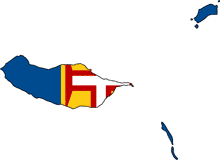
45.88%
4%-20%
15%
Madeira
Income Tax Rate
Madeira
Corporate Tax Rate
Madeira
VAT Rate
Last Update: Nov 2010
(This page may show previous year's tax rates. Always check last update time)


 ALBANIAALGERIAANDORRAANGOLAANGUILLAANTIGUA & BARBUDAARGENTINAARUBAAUSTRALIAAUSTRIAAZERBAIJANBAHAMASBAHRAINBANGLADESHBARBADOSBELARUSBELGIUMBELIZEBENINBERMUDABOSNIA & HERZEGOVINABOTSWANABRAZILBRITISH VIRGIN ISLANDSBRUNEIBULGARIABURKINA FASOBURMABURUNDICAMBODIACAMEROONCANADACAPE VERDECAYMAN ISLANDSCENTRAL AFRICAN REP.CHADCHILECHINACOLOMBIACOMOROSCONGO, DEM. REPUBLICCONGO, REPUBLIC OFCOOK ISLANDSCOSTA RICACOTE D'IVOIRECROATIACUBACURAÇAOCYPRUSCZECH REPUBLICDENMARKDJIBOUTIDOMINICADOMINICAN REPUBLICECUADOREGYPTEL SALVADOREQUATORIAL GUINEAESTONIAFIJIFINLANDFRANCEFRENCH POLYNESIAGAMBIAGEORGIAGERMANYGHANAGIBRALTARGREECEGRENADAGUATEMALAGUERNSEYGUYANAHONDURASHONG KONGHUNGARYICELANDINDIAINDONESIAIRANIRELANDISLE OF MANISRAELITALYIVORY COASTJAMAICAJAPANJERSEYJORDANKAZAKHSTANKENYAKUWAITLATVIALEBANONLIBYALITHUANIALUXEMBOURGMACAUMADAGASCARMADEIRAMALAWIMALAYSIAMALDIVESMALTAMAURITIUSMEXICOMOLDOVAMONACOMONTENEGROMOROCCOMOZAMBIQUEMYANMARNAMIBIANEPALNETHERLANDSNETHERLANDS ANTILLESNEW ZEALANDNICARAGUANIGERIANORWAYOMANPAKISTANPALESTINEPANAMAPAPUA NEW GUINEAPARAGUAYPERUPHILIPPINESPOLANDPORTUGALPUERTO RICOQATARROMANIARUSSIARWANDASAUDI ARABIASENEGALSERBIASIERRA LEONESINGAPORESLOVAKIASLOVENIASOUTH AFRICASOUTH KOREASPAINSRI LANKASWAZILANDSWEDENSWITZERLANDSYRIATAIWANTANZANIATHAILANDTUNISIATURKEYTURKS AND CAICOSUGANDAUKRAINEUNITED ARAB EMIRATESUNITED KINGDOMUNITED STATESURUGUAYUZBEKISTANVANUATUVENEZUELAVIETNAMWEST BANKYEMENZAMBIAZIMBABWE





© 2009-2012 TaxRates.cc
2011 - 2012 Tax Rate Guide and Tax Help Website