Iceland Tax Rates
Iceland imposes 3 levels of taxation of individual income other than investment income:
income up to ISK 2,400,000 is taxed at 24.1%
income from ISK 2,400,001-7,800,000 is taxed at 27%
income above ISK 7,800,001 is taxed at 33%
The municipal tax on the same income varies between 11.24% and 13.28%, the average being 13.12%. Gross individual investment income exceeding ISK 100,000 is taxed at 18%.
As a general principle, any individual who stays in Iceland for more than 183 days during any twelve-month period is considered a resident from the date of arrival. Resident individuals are fully liable for tax payments in Iceland on their worldwide income. The tax liability ends as soon as the individual leaves Iceland. However, former domiciles remain fully tax liable in Iceland for three years after leaving the country, unless they prove that they have become subject to taxation in another country.
Non-resident individuals staying temporarily in Iceland for 183 days or less, and who derive income from employment during their stay, are subject to national income tax on such income. They are allowed the same deductions for expenses as residents. The annual personal tax credit is applied in proportion to their stay in Iceland. Non-resident individuals staying temporarily in Iceland are also subject to municipal income tax in the same manner as residents. Other non-resident individuals are subject to national income tax and municipal income tax on their income from Iceland.
Icelandic-source income in the form of remuneration to directors and committee members, grants, or remuneration for independent personal services and art performances is taxed by assessment at a rate of 15% plus the average municipal income tax rate which was 13.10% in income year 2009 and 13.12% in 2010.
TAXABLE INCOME
The concept of taxable income includes all kind of payments made in cash and by other means and the monetary value can be ascertained. No significant items of compensation are taxexempt in Iceland.
Taxable income is divided into three main categories:
- Category A comprises wages and salaries, including presumptive employment income of the self-employed (see below), employment-related benefits, retirement pensions, social security payments, grants, payments to copyright holders, royalties, etc.
- Category B comprises income from a business and income from an independent economic activity.
- Category C comprises investment income such as dividends, interest, and capital gains.
The categorization is important because only deductions expressly provided for by law may be deducted from the income falling under Categories A and C, and operating losses may only be deducted from income falling under Category B.
In computing the income tax of individuals not engaged in a business, the net results of Categories A are aggregated. Any Category C income derived by such individuals is taxed separately at a flat rate of 18%.
A self-employed individual must declare as employment income an amount comparable to the remuneration he or she would receive if employed by an unrelated person (presumptive employment income). The same applies if an individual works for a partnership, in which he or she participates directly or indirectly as an owner. Furthermore, the spouse and children under 16 years of age who work for the taxpayer's business or partnership must declare as employment income an amount comparable to the remuneration they would receive if employed by an unrelated person. An amount equal to the individual's own presumptive income, or to that of his spouse or children, is deductible as operating expenses from the income of the private or partnership business, whichever is appropriate. If the presumptive income declared by an individual is lower than that which he or she would earn if employed by an unrelated person, the Internal Revenue Directorate may increase his or hers presumptive income. The presumptive income may not lead to an operating loss higher than the total sum of ordinary depreciation. The Minister of Finance issues an indicative list of salaries for this purpose.
The business income of individuals is subject to the same rules regarding the computation of taxable income as is the business income of companies. Individuals are subject to the same special taxes as companies, but income tax is levied at the rate applicable to individuals, not at the corporate income tax rate.
The treatment of interest income and expenses depends on whether they relate to a business or not. Interest income connected with a business is taxed in the same manner as other business income, whereas private interest income is subject to a flat 18% income tax of income in excess of ISK 100,000 pr. year. In case of individuals who are married or taxed jointly as cohabitants the investment income is taxed in the hands of the partner with the higher employment income. In that case the interest income below ISK 200,000 will not be taxed. However 70% of rental income will be taxed by 18%. The other 30% of the rental income will not be taxed. Similarly, interest expenses of a business are fully deductible, whereas private interest expenses are not deductible. Investment income (Category C) of married couples and cohabiting persons who are treated as married couples for tax purposes (herein-after referred to collectively as couples) is taxed in the hands of the individual whose total employment income (Category A) is the higher. Other types of income are taxed separately.
The income of a child under 16 years of age, other than employment income, is taxed together with the income of the parent who has higher employment income or who receives children's benefits for the child. Employment income of a child younger than 16 years exceeding ISK 100,745 is always taxed in the hands of the child itself at a special rate of 6% (4% national income tax and 2% municipal income tax). Subject to certain conditions, all of a child's income may be taxed in the hands of the child itself. A child does not enjoy personal tax credits, see Tax Credits section below.
The income of an individual, if that income is derived from a partnership that is not a separate entity for tax purposes, is taxed together with that individual's other income (Category B).
In principle, all benefits in kind are included in taxable income. In some cases for example, with regard to company cars, special rules apply. There are no special provisions relating to the remuneration of directors. Such income is taxed as employment income in the normal manner (Category A).
There are no special provisions regarding pensions. They are taxed as employment income in the normal manner (Category A).
Capital Gains
Capital Gains From the Sale of Immovable Property Gains from the sale of privately owned immovable property are included in taxable investment income (Category C) and taxed at the rate of 18%. Losses on the sale of such property are generally not deductible; however, they may be deducted from gains made on the sale of similar property in the same year.
Gains from the sale of a private residence are tax-free if the taxpayer has owned the residence for at least two years and its size is within certain limits. If the taxpayer has owned such a residence for less than two years, the gains may be rolled over through a reduction in the acquisition cost of another residence.
Taxation of such gains may be deferred for two years, counted from the end of the year in which the sale takes place. Reinvestment in another residence can be made in Iceland or any country within the EEA, EFTA or the Faroe Islands.
Gains from the sale of immovable or movable property in the course of a business or an independent economic activity are included in taxable business income (Category B) and are calculated in the same manner as capital gains made by companies. The rules regarding deferral of taxation also apply.
Capital Gains from the Sale of Shares
Gains from the sale of privately owned shares are generally included in taxable investment income (Category C) and taxed at the rate of 18% (by assessment).
Capital Gains from the Sale of Movable Property
An individual's gains from the sale of private (non-business) movable property are generally not included in taxable income. Gains from the sale of immovable or movable property in the course of a business or an independent economic activity are included in taxable business income (Category B) and are calculated in the same manner as capital gains made by companies. The rules regarding deferral of taxation also apply.
Tax Allowances, Tax Deductions and Tax Credits
Deductions for Expenses
Payments to obligatory pension funds are deductible up to 4% of total Category A income (employment income) and an additional up to 6% for the income period January - September 2010 and up to 4% for the income period October - December 2010 for payments into alternative pension funds (total up to 10% for income period January - September 2010 and 8% for income period October - December 2010).
Otherwise, no significant deductions are allowed from employment income.
With respect to business income (Category B), expenses incurred for the purpose of obtaining, securing, and maintaining taxable income can generally be deducted.
Tax Credits
All individual taxpayers are entitled to a personal tax credit against the computed income tax from all income categories. This credit amounts to ISK 506,466 for the income year 2009 (assessment year 2010) and 530,466 or the income year 2010 (assessment year 2011). If the credit is higher than the tax, the excess will be applied by the State Treasury to settle the municipal tax payable. Any part of a single person's credit remaining thereafter will be cancelled.
In the case of a married person (or a cohabiting person taxed as if married) the unused credit is added to the credit of the spouse. A member of a crew of an Icelandic ship is entitled to a credit against his computed income tax. This so called "sailor's credit" is a specified sum for each day the sailor is employed on board a ship. This credit is deducted from the computed income tax before the personal tax credit, and its amount is limited to the amount of income tax computed on the basis of wages received from the employer in question. The amount per day for income years 2009 and 2010 is ISK 987.
Losses
Losses on the sale of private (non-business) property are generally not deductible; however, they may be deducted from gains made on the sale of similar properties in the same year. Operating losses may only be deducted from business income (Category B). The net operating loss may be carried forward for 10 years. Carry-back is not allowed.
Assessment and Payment of Taxes
The tax year is the calendar year.
The Internal Revenue Directorate annually decides the last day of filing individual income tax returns. That day is the 23 March for the income year 2009.
The collection of individual income taxes (state and municipal) on employment income (Category A) takes place at source each month during the income year. Individuals deriving business income (Category B) or investment income (Category C), on which tax is not collected at source, may on their own initiative, pay the difference between the tax to be assessed and the amount already paid at source by 31 January following the tax year.
Final assessment for individuals takes place on the basis of the tax returns before the end of July of the year following the tax year. Any difference between income tax withheld and the assessed income taxes (national and municipal) is refunded, increased by 2.5% of the difference; any deficit is collected, increased by 2.5%.
Expatriate Tax
There are in general no special provisions for expatriates. However, expatriates with an foreign E101 are not liable to pay social security contributions or contributions to Pension Funds in Iceland. Instead, these employees shall pay social security contributions and contributions to pension funds in their home countries.
Double Taxation Relief
The bilateral and multilateral tax treaties concluded by Iceland provide for relief from double taxation of income in the form of a credit for foreign tax or an exemption of foreign income.
A tax credit for foreign tax on income from non-treaty countries may be granted against national income tax at the discretion of the Internal Revenue Directorate.
Private Housing Benefits
The State Treasury provides compensation for interest expense incurred by individuals who purchase a residence for their personal use. The amount of interest compensation is based on the interest on loans obtained for the purpose of financing the purchase of the residence. The benefits are income and net wealth related. There are limitations on the amount of interest that may be used as the basis for the calculation of the compensation, as well as limitations on the amount of the interest compensation itself.
The maximum private interest relief in assessment year 2010 are ISK 246,944 for an individual; ISK 317,589 for single parents; and ISK 408,374 for couples.
Child Benefits
Child benefits are payable to individuals or couples for all children under the age of 18 supported by the individuals. There are two types of child benefits: a fixed amount paid for all children under 7 years of age; and child benefits calculated on the basis of the following:
- Family type (couple or single parent),
- Number of children in the family,
- Income and net wealth of the family.
Advance payments of 50% of the estimated child benefits for a certain year are made on 1 February and on 1 May. Following the tax assessment in the end of July, the remaining part of the child benefits are paid on 1 August and 1 November.
Annual child benefit rates in the year 2010
Child Benefits regardless of Income
Fixed amount paid for all children under 7 years of age ................. ISK 61,191
Child Benefits linked to Family Type and Income
Couples
For one child ............................................................................. ISK 152,331
For each child exceeding one ...................................................... ISK 181,323
Single parents
For one child ............................................................................. ISK 253,716
For each child exceeding one ...................................................... ISK 260,262
For couples with income in 2009 exceeding ISK 3,600,000 and for single parents with income exceeding ISK 1,800,000 the benefits are reduced by a certain percentage of the income in excess of that amount. The percentage is 2% in case of one child, 5% if two children, and 7% in case of three or more children.
Corporate taxation in Iceland
The corporate income tax rate in Iceland is:
18% for limited liability companies; and
32.7% for other legal entities registered as taxable entities.
The Icelandic tax system for corporations is a classical system. Companies are subject to income tax on their worldwide income and economic double taxation may be eliminated by deduction of dividend income from taxable income. Dividends received by individuals and other non-corporate shareholders are taxed at a lower rate than earned income.
Taxable Income
The taxable base is the net income; i.e. income after deduction of operating expenses. Operating expenses are expenses incurred when obtaining and maintaining the income, including interest, discount on securities, exchange rate losses, provision for doubtful accounts receivable and depreciation, and certain allowances provided by law.
Valuation of Inventories
The value of inventories of raw materials and finished goods at year end is determined on a first-in-first-out (FIFO) basis or by the average cost method. In computing the value of goods produced, both direct and indirect production costs must be taken into account. Inventories are stated at the lower of cost or net realisable value. For tax purposes inventories can be further written down by 5% of their calculated value.
Reserves and Provisions
Companies are allowed for tax purposes to maintain a reserve for bad debt up to 5% of the accounts and notes receivable at year end. Special rules apply to bad debt reserves of banks.
Tax Losses
Tax losses may be carried forward and offset against taxable income in the following ten years. No carry-back is allowed.
Capital Gains
Capital gains from the disposal of assets used in operation or held as an investment, whether depreciable or not, constitute taxable income, regardless of the holding period. In certain cases, taxation of capital gain can be deferred by applying the rollover relief method.
Capital gains are taxable in the year the transfer of ownership occurs. However, in the same year, the taxpayer may record accelerated depreciation of other depreciable assets on hand if the gain resulted from the sale of depreciable assets. If the taxpayer does not own assets that can be depreciated, taxation of the gains may be deferred for two years, from the end of the year in which the transfer of ownership occurs. Accelerated depreciation and/or deferral of taxation of capital gains are subject to the restriction that the depreciation or deferral may not create a taxable loss in the year it is applied.
As a general rule, capital gain from the disposal of non-depreciable immovable property is the difference between the sales price of the property and its original purchase price.
If part of the proceeds from sale of assets is paid in instalments over a period of three years or more, the seller has the option of spreading the taxation of that part of the gain evenly over the repayment period, up to a maximum of seven years. This alternative is available only if carry-forward losses have been equalised.
Finally, it should be noted that gains from a sale of property are, in general, taxable in full as ordinary income if the taxpayer's business is to construct or purchase property for resale. The same applies if a taxpayer acquires property solely for the purpose of making a profit.
Disposal of Shares
Capital gains from the sale of shares must be declared as income. Limited liability companies can deduct in full the amount of the capital gain, with 0% tax effect when (1) the disposed shares are shares in Icelandic companies; and when (2) the disposed shares represent participations in foreign companies and the seller can demonstrate (a) that the foreign company's profit has been taxed abroad under provisions that do not substantially deviate from those prevailing in Iceland; and (b) that the profits of the foreign company have been subject to taxation at a rate that is not lower than the general tax rate in any OECD, EEA or EFTA country or Faroe Islands. The deduction is only permissible after carry-forward losses have been settled, including the loss of the income year. From 1 January 2011 the deduction only applies if the seller owned at least 10% of the company's shares on the date of the sale.
Losses from sale of shares do not constitute taxable losses or carry-forward losses by companies. Such losses can only be offset against gain on sale of shares in the same year.
Depreciation
Depreciation for income tax purposes is calculated by using the straight line method with regard to immovable property, non-sustainable natural resources, acquired intellectual property rights and acquired goodwill, whereas gradual depreciation is employed with regard to movable property.
Assets subject to ordinary depreciation are classified in various categories, with different annual depreciation rates for each. The rates within a category are optional and can be changed from one year to another.
The depreciation base of movable property is its book value at the beginning of each year, whereas the depreciation base of other depreciable assets is cost price.
The depreciation period of an asset starts at the beginning of the year that the asset is put into use. Residual value equal to 10% of real estate and movable properties original value remains on account until the asset is disposed of. Accelerated and/ or extraordinary depreciation or write-offs are deductible from income in certain limited and specific cases. No depreciation is expensed on an asset in the year of its sale.
The cost of acquiring production rights in agriculture can be amortized in full over a period of five years with equal annual amounts.
Following assets can be fully expensed in the year of acquisition or amortized with equal annual amounts over a period of five years:
- Start-up cost such as registration cost and the cost of acquiring necessary official permits and licenses.
- Expenses relating to trial runs, marketing, research, patents and trademarks.
When the cost of an asset or a group of assets is less than ISK 250,000 such assets may be expensed in full in the year of acquisition.
Groups of Companies
Consolidated Taxation
Companies may opt for consolidated taxation if a company owns at least 90% share in another company. Consolidated taxation means, among other things, that losses of one company can be offset against profits of other companies. Consolidated taxation cannot be extended to non-resident companies or permanent establishment of foreign companies.
Inter-Company Dividends
Dividends received by one resident limited liability company from another can be deductible from taxable income of the recipient company. The condition for deductibility is that the loss of the year and carry forward losses have been offset. From 1 January 2011 there is also a condition that the receiver of dividend must hold at least 10% in the legal entity paying the dividend at the end of the year which the dividend payment relates to.
The deduction also applies to foreign dividends received if the resident recipient company can demonstrate (1) that the dividends are received from companies whose profits have been taxed under provisions that do not substantially deviate from those prevailing in Iceland, and (2) that the profits of the foreign companies have been subject to taxation at a rate that is not lower than the general tax rate in any OECD, EEA, EFTA country or Faroe Islands.
Anti-Avoidance
The Icelandic Supreme Court has held, with a reference to the main underlying principle behind Article 57 of the Income Tax Act, that transactions may be disregarded if their purpose is only to circumvent tax.
Transfer Pricing
According to a general provision of Icelandic tax law, financial transactions between taxpayers that differ substantially from those generally applicable to such transactions (not at arm's length), any financial benefit or advantage that would have accrued to one of the parties, but did not accrue to that party, may be added to that party's taxable income. The Internal Revenue Directorate (Ríkisskattstjóri) may also determine a reasonable purchase or sales price if property is acquired at an abnormally high price or sold at an abnormally low price. The above provisions also apply to possible adjustments of taxable profits where an Icelandic business entity controlled by a foreign enterprise is subject to trade terms different from those that would normally apply between independent business entities.
Thin Capitalization
Icelandic tax law includes a general anti-avoidance clause that may be applicable to such cases.
Controlled Foreign Company
A taxable party that owns a share in a company resident in a low tax jurisdiction shall pay income tax on the company's profits in proportion to its shareholding without regard to dividend distribution. The same applies to a taxable party managing a company or an asset portfolio in a low tax jurisdiction from which the taxable party derives direct or indirect benefits.
Tax Incentives
Icelandic tax law provides for tax incentives in relation to film making in Iceland. Reference is made to chapter 12 for more information.
There are various tax incentives available to those who support innovation in Iceland. The main incentives are both available for investors and also the innovation companies providing certain conditions are met. The tax incentives are as follows:
- Individuals investing in defined innovation companies can annually deduct up to ISK 300.000 (ISK 600.000 for couples) of the investment from taxable income.
- Companies investing in defined innovation companies can annually deduct up to ISK 15.000.000 of the investment from taxable income.
- Defined innovation companies can annually deduct 15% of their annual research and development expenses from income tax liabilities. If the amount of the deduction is higher than the tax liability the difference is reimbursed. The amount of the annual qualifying research and development expenses is limited to ISK 50.000.000 for each company and ISK 75.000.000 if service is purchased from other innovation companies.
Other Taxes and Charges
Real Estate Tax
Municipalities levy an annual real estate tax on the official premises valuation of immovable property. The amount of the tax varies (up to 3%), depending on the municipality and the type of real estate.
Social Security Contributions
In the case of salaries paid to employees, social security contributions are payable by employers and self employed persons.
Social security contributions are imposed on all employees and self employed persons remuneration (for example salaries, benefits and the employer's part of premiums to the pension funds). The contributions are partly used to finance the social security system. For income year 2010 the general rate is 8.65%. An additional 0.65% is payable with respect to sailors. If an employee has a foreign E-101 certificate the social security contribution is 0.632%.
Both employees and employers are required to pay premiums into pension funds. Collectively, the minimum payment is 12% of gross salary. The employees' part is usually 4% which is deductible from the salary income tax base. Employers provide minimum 8% in addition to the employees' contribution. Self employed persons pay both the employee's and employer's part of the pension fee.
Furthermore, employees may choose to make additional payments of 6% for the income period January - September 2010 and 4% for the income period October - December 2010 into pension funds. If employees choose to make the additional payments, the employer is obliged to pay an additional 2% premium to the pension funds for the benefit of the employees.
Industrial Charge
An industrial charge is assessed on all industrial activities of tax payers. The taxable base is the sale of goods and services of any kind. For income years 2009 and 2010 (assessment years 2010 and 2011), the rate is 0.08% levied on total turnover.
Agricultural Charge
An agricultural charge is assessed on all agricultural activities of tax payers. The taxable base is the sale of goods and services of any kind. For income years 2009 and 2010 (assessment years 2010 and 2011), the rate is 1.20% levied on total turnover.
Hydrocarbon Charge and Tax
On 1 January 2009, Iceland enacted Law no. 170/2008 on Taxation of Processing of Hydrocarbons implementing a hydrocarbon charge or, in certain cases a tax, on the search for, research into and processing of hydrocarbons (crude oil, natural gas etc) and related activities mainly in the Icelandic territorial waters, the economic zone and the continental shelf.
The hydrocarbon charge is expressed as a certain percentage of the annual value of the volume processed hydrocarbons. If taxable profit for a certain year corresponds to 20% or more of the taxable operating revenues of the taxable person, the hydrocarbon charge is replaced with a hydrocarbon tax and levied on net profit.
Assessment and Payment of Taxes
The tax year is the calendar year. Under certain circumstances, permission to use a tax year different from the calendar year may be granted by the Internal Revenue Directorate upon application.
Each year the Internal Revenue Directorate decides the last day of filing corporate income tax returns, together with supporting documents. That date is 31 May 2010. Upon the filing of an application, extensions may be granted by the Internal Revenue Directorate. Assessment is completed within 10 months from the end of companies accounting period.
Companies are required to make advance tax payments each month, except January and October, until assessment has been completed. The instalments are determined as a given percentage of the previous year's assessment, or 8.5% per month in 2010. Any deficit remaining when final tax is assessed must be paid in equal instalments in November and December.
Payments of withholding tax on dividends and interest income received in 2010 are due quarterly, on 15 April 2010, 15 July 2010, 15 November 2010 and 15 January 2011 and deadline for payment is 15 days later.
Non-Resident Companies
Non-resident companies are subject to income tax on their
income from Icelandic sources as shown in the following table:
Tax base LLC Legal entities other than LLC
Income from services carried out in Iceland Net income 18% 32.7%
Income from a permanent establishment Net income 18% 32.7%
Income from immovable property Net income 18% 18%
Income from Iceland (royalty, patent and capital gain on movable property) Gross income 18% 18%
Dividends and capital gain from Icelandic shares Gross income 15% 15%
Interest arising in Iceland Gross income 15% 15%
Withholding Tax
Dividends
Dividends paid by resident companies to shareholders are subject to withholding tax. For the income year 2010 the rate is 18% for all recipients other than non-resident legal entities for which the rate is 15%. The withholding tax is not final for Icelandic and other EEA resident companies, but is reimbursed in connection with the ordinary tax assessment in October the year after the distribution has taken place, presupposed that an Icelandic tax return has been filed.
A request can be filed to the Internal Revenue Directorate to apply tax treaty rates on dividend distributions.
If a company is liquidated without a merger, any distributions in excess of the purchase price of the shares shall be treated as dividends for tax purposes.
Interest
Interest paid to residents and non-residents is subject to a withholding tax. For the income year 2010 the rate is 18% for all recipients other than non-resident legal entities for which the rate is 15%. The rate can be reduced by applicable double taxation treaties presuming that an application for exemption is filed at the Internal Revenue Directorate.
Royalties
Royalties paid by resident companies to non-residents are subject to a withholding tax. The rate for income year 2010 is 18%. The tax rate can be reduced by applicable double taxation treaties.
Double Taxation Relief
The bilateral and multilateral tax treaties concluded by Iceland provide for relief from double taxation of income in the form of a credit for foreign tax or an exemption of foreign income.
A tax credit for foreign tax on income from non-treaty countries may be granted against national income tax at the discretion of the Internal Revenue Directorate.
Establishing a Company in Iceland
Establishing a company in Iceland is simple as the procedure is fast (usually takes 2-4 days) and the registration fees are moderate.
The most common business form in Iceland is the limited liability company (LLC). There are two types of limited liability companies: a public limited liability company and a private limited liability company.
A public limited liability company must have at least two founders but the private limited liability company may have only one founder. In both cases, at least one of the founders must be either (1) a resident of Iceland or (2) a citizen as well as a resident of the Faroe Islands or an EEA or EFTA country. The Minister of Commerce may grant an exemption from the residence condition. The minimum initial capital of a public limited liability company is ISK 4,000,000, whereas the minimum initial capital of a private limited liability company is ISK 500,000.
There are no conditions regarding the holding of each shareholder. A stamp duty (capital duty) of 0.5% is levied on the nominal value of share certificates issued by private and public limited liability companies. Private limited liability companies are not required to issue share certificates.
Foreign limited liability companies may establish branches in Iceland. Foreign limited liability companies with legal residency in the EEA and conduct business in Iceland on the basis of a single contract engagement also have the option of a more simple form of registration.
Companies may keep their books and prepare financial statements in foreign currencies subject to certain conditions.
iceland vat (value added tax)
The standard VAT rate in Iceland is 25.5%.
A reduced VAT rate of 7% applies to the following goods and services:
- The rental of hotel and guestrooms and other accommodation (incl. campground facilities).
- Sales of food and other goods for human consumption. The standard VAT rate 25.5% applies to sales of alcoholic beverages.
- Sales of books, audio books, magazines, newspapers and national and regional periodicals.
- Sales of hot water, electricity and fuel oil used for heating of houses and swimming pools.
- Radio and TV broadcasting license and subscription charges.
- Road tolls.
- Compact discs, records, tapes and other comparable mediums with music, not picture (excluded DVD's).
As stated in introductory provision of the Value added tax Act, no. 50/1988, a value added tax (VAT) shall be paid to the Treasury of all inland transactions at all stages, as well as of imports of goods and services. In principle, the tax liability covers all goods and valuables, new and used. The tax liability covers also all labour and services, regardless of name.
Taxable Transaction
As a general rule, VAT shall be paid to the Treasury on all inland transactions at all stages, as well as on imports of goods and services. Exemptions are specified in the VAT Act. For example health services, education, passenger transportation, rental of properties, athletic activities and social services are exempt from
VAT.
Taxable and Tax-Exempt Parties
The duty to collect VAT and submit the proceeds to the Treasury is, as a general rule, imposed upon those who sell or deliver goods or valuables on a professional or independent basis or perform taxable labour or service.
A nonresident entrepreneur that does not have an office, or other fixed place of business, must appoint a representative who shall be legally obligated to carry out the non-resident entrepreneur's duties as they relate to registration, the submission of returns, etc. If a non-resident entrepreneur fails to appoint a representative in Iceland and neglects to register his enterprise, the purchasers of his services are responsible for the remittance of the tax due on the amount of the purchase (reverse charge).
Taxable Amount
The tax price is the price on which VAT is calculated upon the sale of goods and valuables, taxable labour and services. The tax price refers to total remuneration or total sales value before VAT. In other words the taxable amount is the actual sales price (excluding the VAT itself) of goods and services.
Taxable Turnover
The taxable turnover of a registered party includes all sales or deliveries of goods and valuables against payment, as well as sold labour and services. This includes the sales value of goods or taxable services that a company sells or produces or an owner withdraws for his own use. Taxable turnover includes also sales or delivery of goods sold on a handling or agent basis and sales and delivery of machinery, instruments and equipment.
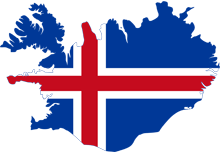
46.28%
18 or 32.7%
25.5%
Iceland
Income Tax Rate
Iceland
Corporate Tax Rate
Iceland
VAT Rate
Last Update: Nov 2010
(This page may show previous year's tax rates. Always check last update time)
 ALBANIAALGERIAANDORRAANGOLAANGUILLAANTIGUA & BARBUDAARGENTINAARUBAAUSTRALIAAUSTRIAAZERBAIJANBAHAMASBAHRAINBANGLADESHBARBADOSBELARUSBELGIUMBELIZEBENINBERMUDABOSNIA & HERZEGOVINABOTSWANABRAZILBRITISH VIRGIN ISLANDSBRUNEIBULGARIABURKINA FASOBURMABURUNDICAMBODIACAMEROONCANADACAPE VERDECAYMAN ISLANDSCENTRAL AFRICAN REP.CHADCHILECHINACOLOMBIACOMOROSCONGO, DEM. REPUBLICCONGO, REPUBLIC OFCOOK ISLANDSCOSTA RICACOTE D'IVOIRECROATIACUBACURAÇAOCYPRUSCZECH REPUBLICDENMARKDJIBOUTIDOMINICADOMINICAN REPUBLICECUADOREGYPTEL SALVADOREQUATORIAL GUINEAESTONIAFIJIFINLANDFRANCEFRENCH POLYNESIAGAMBIAGEORGIAGERMANYGHANAGIBRALTARGREECEGRENADAGUATEMALAGUERNSEYGUYANAHONDURASHONG KONGHUNGARYICELANDINDIAINDONESIAIRANIRELANDISLE OF MANISRAELITALYIVORY COASTJAMAICAJAPANJERSEYJORDANKAZAKHSTANKENYAKUWAITLATVIALEBANONLIBYALITHUANIALUXEMBOURGMACAUMADAGASCARMADEIRAMALAWIMALAYSIAMALDIVESMALTAMAURITIUSMEXICOMOLDOVAMONACOMONTENEGROMOROCCOMOZAMBIQUEMYANMARNAMIBIANEPALNETHERLANDSNETHERLANDS ANTILLESNEW ZEALANDNICARAGUANIGERIANORWAYOMANPAKISTANPALESTINEPANAMAPAPUA NEW GUINEAPARAGUAYPERUPHILIPPINESPOLANDPORTUGALPUERTO RICOQATARROMANIARUSSIARWANDASAUDI ARABIASENEGALSERBIASIERRA LEONESINGAPORESLOVAKIASLOVENIASOUTH AFRICASOUTH KOREASPAINSRI LANKASWAZILANDSWEDENSWITZERLANDSYRIATAIWANTANZANIATHAILANDTUNISIATURKEYTURKS AND CAICOSUGANDAUKRAINEUNITED ARAB EMIRATESUNITED KINGDOMUNITED STATESURUGUAYUZBEKISTANVANUATUVENEZUELAVIETNAMWEST BANKYEMENZAMBIAZIMBABWE





© 2009-2012 TaxRates.cc
2011 - 2012 Tax Rate Guide and Tax Help Website